 Stephanie Walsh
Most coverage of the APsystems EZ1-LV launch this week is treating it like a gadget story. It’s not. It’s a signal that plug-in solar, already a mainstream product category across Germany and the Netherlands, is finally getting a serious commercial push in the U.S., and the timing is not accidental.
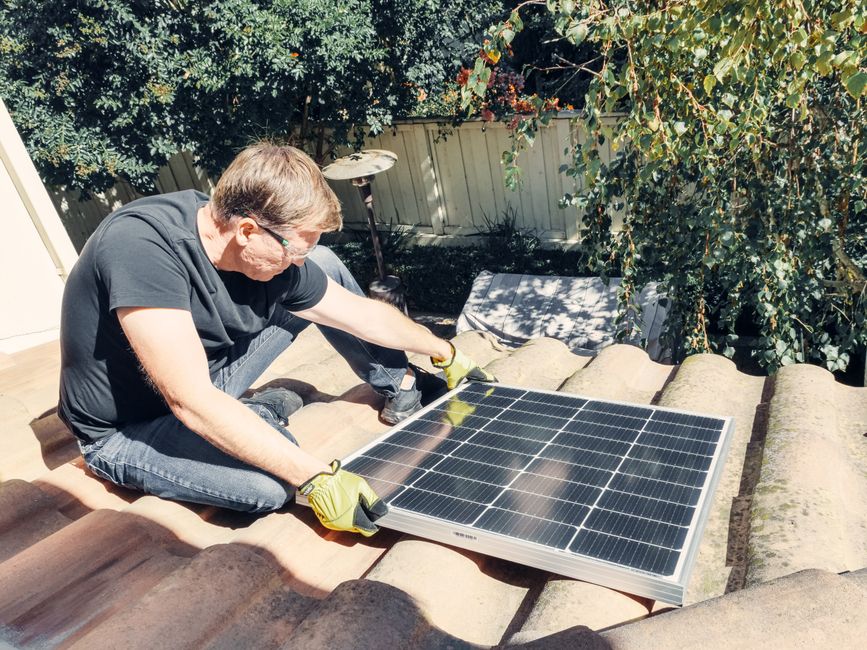
APsystems formally introduced the EZ1-LV to the U.S. market on July 17, 2026, per pv magazine USA, about five months after quietly opening direct-to-consumer sales in February. The unit costs $325 and plugs into a standard 120V wall outlet via a 5-meter extension cable. No licensed electrician, no permit in most jurisdictions, no utility interconnection paperwork. You mount two panels, plug it in, and the inverter pushes power onto your home circuit. That’s the whole install.
The context matters as much as the product. The Section 25D federal tax credit, which knocked 30% off residential solar system costs, expired at the end of 2025. For a homeowner who was looking at a $20,000 rooftop system, that’s $6,000 gone. Suddenly a $650 plug-in setup that handles real baseload looks a lot more interesting than it did eighteen months ago.
- APsystems EZ1-LV launched in the U.S. July 17, 2026; direct sales started February 2026 at $325/unit.
- Delivers 900 VA continuous AC output; two units on one 15A circuit yield up to 1,800W.
- No electrician or utility interconnection required; UL 3700 certified with a 12-year warranty.
- Section 25D 30% tax credit expired end of 2025, making low-cost entry solar more attractive.
- Supports PV modules from 315 Wp to 660 Wp per channel.
What the EZ1-LV Actually Does (and Doesn’t Do)
Let’s be precise about the output. The EZ1-LV runs two PV input channels and delivers 900 VA of continuous AC power into a standard outlet. That’s not 900 watts of panel capacity, it’s the inverter’s AC output ceiling. You can feed it panels ranging from 315 Wp to 660 Wp per channel, so a pair of current 400W panels is squarely in the target zone.
Pair two EZ1-LV units on a single 15A circuit and you’re at 1,800W of potential solar feed. To be real with you: a 15A, 120V circuit is rated for 1,800W total (15A x 120V), and NEC’s 80% continuous load rule means you should treat 1,440W as your safe ceiling if that circuit has any other load on it. That’s a real constraint. Know your circuit before you plug in a second unit.
What it won’t do: it won’t fill the gap left by a whole-home rooftop array, it won’t qualify for battery backup, and it won’t satisfy the homeowner who needs to offset a 1,500 kWh monthly bill. It’s a precision tool for apartment dwellers, renters, homeowners who can’t get HOA approval for rooftop panels, or anyone who wants to offset a specific load, say a chest freezer, a home office circuit, or an EV Level 1 charger.
The UL 3700 Certification Is the Detail That Actually Matters
Helpful resource: Emporia Smart Outlet with Energy Monitoring is a top-rated option for this. (As an Amazon Associate this site earns from qualifying purchases.)
Europe got plug-in solar moving partly because the regulatory framework was clear. Germany’s VDE standard and later EU rules created a defined category: balcony power plants under a certain wattage, simple registration, no full utility interconnection. The U.S. didn’t have a clean equivalent until UL 3700 arrived.
UL 3700 is the standard for plug-in inverter systems. It covers anti-islanding protection, the safety mechanism that shuts the inverter down if grid power drops, so you’re not backfeeding a downed line. The EZ1-LV carries that certification, which is why it can legally plug into a normal outlet rather than requiring a dedicated hardwired circuit with a utility-approved interconnection agreement.
This is what separates the EZ1-LV from the gray-market “balcony inverter” units that have been floating around Amazon for two years. Those units may or may not have proper anti-islanding. The APsystems unit, as noted in the July 17 pv magazine USA launch coverage, is UL 3700 certified. That’s the difference between a product you can stand behind with your utility and one you’re hoping nobody asks about.
The Math: Where Plug-In Solar Actually Pencils Out
The Section 25D credit expiring changes the calculus for entry-level buyers specifically. A $325 unit with no installation labor is a very different conversation than a $15,000-$25,000 rooftop system.
| Configuration | Hardware Cost | AC Output | Estimated Annual Production* |
|---|---|---|---|
| 1x EZ1-LV + 2x 400W panels | ~$900-$1,100 | 900 VA | ~900-1,100 kWh |
| 2x EZ1-LV + 4x 400W panels | ~$1,700-$2,100 | 1,800 VA | ~1,800-2,200 kWh |
| Entry rooftop system (8-10 panels, no 25D credit) | ~$12,000-$18,000 | 3,000-4,000W | ~4,000-5,500 kWh |
*Production estimates assume 4.5 peak sun hours, average U.S. location. Panel costs approximate as of mid-2026.
The plug-in system won’t eliminate your electric bill. But at roughly $0.14-$0.17/kWh in many markets, 1,100 kWh annually saves around $150-$185 per year. Payback on a single-unit kit lands somewhere in the 5-7 year range depending on your electricity rate, your sun hours, and whether you buy panels separately or as a kit through an APsystems distributor. That’s not spectacular, but it’s real, and it’s accessible to people who would never qualify for a solar loan or survive the six-month permit-to-interconnection slog of a rooftop install.
The Renter Angle Is Real This Time
European balcony solar took off fastest among apartment renters, and the reason is obvious: you don’t own the roof. A balcony-mounted panel connected to an interior outlet requires no structural modification to the building, no utility contract, no landlord permission to run conduit. In most cases in the U.S., you’re looking at a conversation with your landlord about whether you can mount a bracket on a balcony railing, which is a very different ask than “can I cut through the roof.”
The EZ1-LV’s 5-meter cable gives you enough reach to bring the connection point inside from a balcony or small backyard setup. APsystems is selling full kits through partner distributors, so renters who want a complete system can avoid sourcing compatible panels separately.
The 12-year warranty matters here too. A renter who moves every few years needs a system that moves with them. The EZ1-LV is a portable asset in a way that a rooftop system absolutely is not.
What to Watch For Before You Buy
A few things worth checking before you order. First, confirm your outlet and circuit. Not every exterior or garage outlet is on its own 15A circuit, and sharing that circuit with a refrigerator or power tools undermines the whole equation. Second, check your HOA rules regardless of whether you’re a renter or owner. Some HOAs prohibit ground or balcony-mounted panels even if they don’t have line-of-sight on your roof. Third, contact your utility. Most utilities don’t require formal interconnection for UL 3700 certified plug-in systems, but some have notification requirements, and you want that documented before you plug in.
One contractor red flag to watch for: any installer who tells you to just plug this in and not tell your utility is giving you advice that could affect your homeowner’s insurance. Do it right. It’s a 10-minute call.
The EZ1-LV is a legitimate product solving a real access problem. It won’t replace rooftop solar for most homeowners. But for the renter in Phoenix, the condo owner in San Diego, or the suburban homeowner who just watched the 25D credit vanish and isn’t ready to commit $18,000, it’s a more honest option than anything the U.S. market has offered at this price point before.
Sources
- APsystems introduces plug-in microinverter for U.S. balcony and DIY solar markets (July 17, 2026)
- APsystems opens direct U.S. sales of EZ1 microinverter for DIY plug-in solar (February 10, 2026)
- APsystems EZ1 Plug-in Microinverter (DIY) (July 2026)
- Solar Market Insight Report Q2 2026 (July 2026)
- APsystems EZ1-LV balcony solar microinverter (July 18, 2026)
Photo: Job1505 De waal via Pexels
Recommended Resources
Disclosure: As an Amazon Associate, we earn a small commission from qualifying purchases at no extra cost to you. We only recommend products that genuinely support the topics covered in this article.
- Renogy 200W Solar Starter Kit + 30A Charge Controller (~$169), Complete beginner solar kit, 200W monocrystalline panel, charge controller, and mounting hardware included.
- Renogy 2×100W Monocrystalline Solar Panels (~$99), Expandable 200W panel set from the most trusted DIY solar brand, used widely in off-grid and home backup systems.