 Rachel Kim
Most homeowners I talk to think solar installation is like getting a new roof: the crew shows up, works a few days, and you’re done. The real number that stops people cold? The average time from signing a contract to the moment your system is actually live is two to four months. Not days. Months. And in some states, I’ve watched it stretch past six.
That gap between “installed in a day” and “operational after months of waiting” is where so much frustration lives. You might be wondering why a physical installation that takes one or two days on your roof requires the better part of a year in some cases. I hear this constantly. The short answer is that the actual rooftop work is almost the smallest part of the process. The rest is paperwork, inspection queues, and utility bureaucracy, and how long those take depends enormously on where you live.
Here’s what I tell people when they sit down with me: plan for two months as your best-case scenario and four as your likely reality. If your installer promises you’ll be producing power in three weeks, ask them what utility they’re working with, because I’ve never seen that timeline hold.
- Full timeline from contract to live system: 2-4 months on average, up to 6+ months in slow markets
- Physical rooftop installation takes 1-3 days for most residential systems
- Permitting and utility interconnection approval account for 80-90% of total project time
- California and New York tend to run slower; Texas and Florida often move faster
- Choosing an installer who handles permitting in-house can trim 2-4 weeks off your timeline
The Two Days You Actually See vs. the Months You Don’t
Let’s separate what happens on your roof from everything surrounding it, because conflating them is the source of almost every timeline disappointment I’ve encountered.
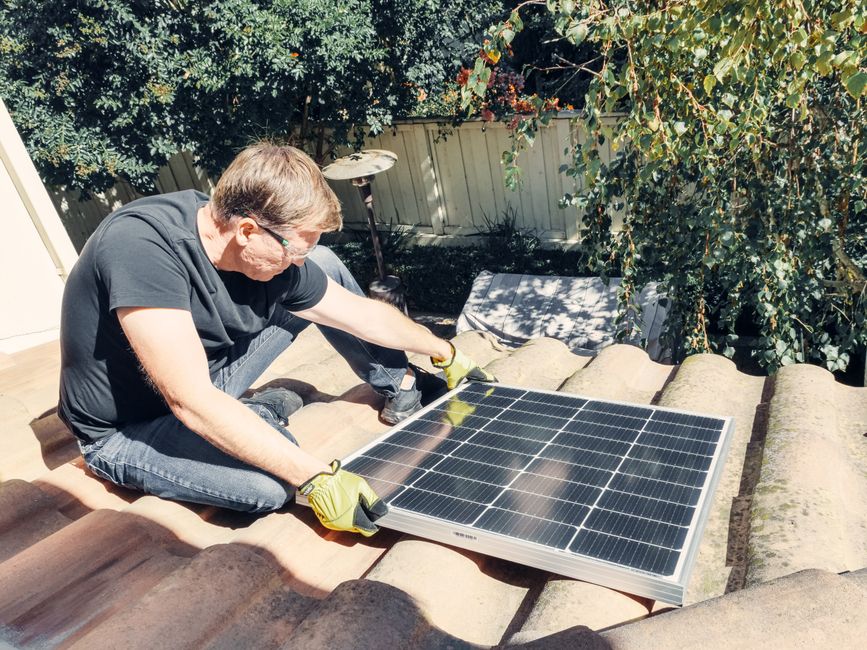
A standard 8-10 kilowatt residential system, say 20 to 24 panels, takes a crew of two or three electricians one to two days to install physically. Larger systems on complex rooflines might push that to three days. A small 5 kW system on a simple gable roof? Sometimes one long day. I’ve done installs like that myself, and we were usually cleaned up and off the property before 4 p.m.
But here’s the thing nobody in the sales meeting emphasizes: that one or two days of visible activity is typically preceded by four to eight weeks of permit processing, and followed by another two to six weeks waiting for utility interconnection approval. You can have panels on your roof for a month before you’re legally allowed to turn the system on. That’s not a contractor failure. That’s just how the process works almost everywhere in the country.
The Full Timeline, Stage by Stage
Helpful resource: P3 Kill A Watt Electricity Usage Monitor is a top-rated option for this. (As an Amazon Associate this site earns from qualifying purchases.)
I want to walk through every stage because each one has a different cause of delay, and knowing which stage you’re in helps you ask the right questions.
Site assessment and system design usually takes one to two weeks after you sign the contract. Your installer sends someone (or uses satellite imagery, which has gotten remarkably accurate) to evaluate your roof pitch, shading, available square footage, and electrical panel situation. If you need a panel upgrade, tack on another week or two, and sometimes more if there’s a permit required for that separately. I’ve seen a needed panel upgrade add six weeks to a project in older Chicago-area homes.
Permit submission and approval is where the wide variation lives. Some jurisdictions, like Maricopa County in Arizona, have streamlined online systems that turn permits around in three to five business days. Others, like many boroughs in New Jersey or neighborhoods in Los Angeles County, are running eight to twelve weeks. That’s not an exaggeration. I’ve had permits pending in LA for eleven weeks. The permit examiner will want to see stamped structural and electrical drawings, which your installer should be producing, so if they’re not providing engineered drawings, that’s a red flag worth raising before you sign.
Installation day(s) happen once permits are approved. This is the fast part.
Utility inspection and interconnection is the final bottleneck. After installation, your local utility (PG&E, Duke Energy, Xcel, whoever) needs to approve the connection to the grid and, in most cases, install a new bi-directional meter. This step alone typically takes two to eight weeks. NREL research has documented this phase as one of the most inconsistent parts of the process nationally, with rural co-ops sometimes running even slower than large investor-owned utilities.
| Stage | Typical Duration | What Causes Delays |
|---|---|---|
| Site assessment + system design | 1-2 weeks | Panel upgrades, complex roofs |
| Permit submission + approval | 1-12 weeks | Local jurisdiction, drawing completeness |
| Installation (on roof) | 1-3 days | System size, roof complexity |
| Utility inspection + interconnection | 2-8 weeks | Utility backlog, meter exchange |
| Total: contract to live system | 2-6 months | Stacking delays at multiple stages |
Where You Live Changes Everything
Complete Hybrid Solar Inverter Wiring Installation | How to Install at Home · Electrical Technologies on YouTube
This is the variable I wish more articles spent time on. The Solar Energy Industries Association has tracked significant regional differences in soft costs, which include permitting and interconnection time, and they’re substantial. A streamlined market like Texas (particularly Austin Energy’s territory) can get you from contract to power in six to eight weeks. Compare that to parts of New England or California’s more congested utility territories, where four to six months is routine and nobody bats an eye.
These numbers are consistent with what NREL’s soft cost research has shown for years, and my own experience installing in the Midwest and advising homeowners nationwide lines up. California and New York aren’t slow because installers there are lazy. They’re slow because they have more layers of local jurisdiction review, stricter utility interconnection rules, and in California specifically, the CPUC’s processes add compliance steps that simply don’t exist in faster states.
A reader named Denise in Westchester emailed me last spring because her installer had been “in permitting” for fourteen weeks. I asked her which utility. She said Con Edison. I wasn’t surprised. Con Edison’s interconnection queue has been notoriously backed up, and unless you have an installer who knows how to navigate their specific process and submits complete applications the first time, resubmissions add weeks each time.
Worked Examples From Real Projects
Small system, cooperative utility, rural Ohio: 6.4 kW system on a simple south-facing ranch roof. Installer submitted a complete permit package on day one, local township turned it around in 12 days, installation took 7 hours, and the rural electric co-op had the interconnection approved in 11 days. Total time: contract to live system in 34 days. This is genuinely the best-case scenario, and it requires everything to go right.
Medium system, investor-owned utility, suburban New Jersey: 10.2 kW system, split between a south and west face, required a 200-amp panel upgrade. Permit for the panel upgrade came back in three weeks, solar permit took another six weeks from that point, installation was two days, PSE&G interconnection approval took five weeks. Total: 4.5 months. Frustrating but completely normal for that territory.
Large system, HOA involvement, suburban Arizona: 14 kW system requiring HOA architectural review before permit submission. HOA took 30 days (standard for that community), permit came back in eight days (Maricopa County is legitimately fast), installation took two and a half days, APS interconnection approved in 19 days. Total: 68 days. The HOA review was the longest single stage.
What Slows It Down (and What You Can Actually Control)
Honestly, most of the timeline is outside your hands. But a few things genuinely help.
Choose an installer who handles permitting in-house with dedicated permit technicians, not one who outsources it to a third-party permit service that treats your project like one of hundreds in a pile. Ask directly: “Who submits our permit and how do they track its status?” A good installer should be able to name a person. In my experience, in-house permitting teams cut two to four weeks off timelines compared to outsourced services, mostly because they catch issues and resubmit faster.
If you have an HOA, get your application in before you even sign with an installer. Most HOA architectural review committees only meet monthly. Missing one meeting date costs you 30 days right there. California’s AB 2188 limited HOA’s ability to block solar for aesthetic reasons, so if you’re in California and getting HOA pushback, know your rights.
Get your electrical panel situation assessed early. If you need a panel upgrade, which happens in a lot of homes built before 1990, find out in week one, not week six. That single discovery, surfaced late, is responsible for more blown timelines than anything else I see.
Sources
- National Renewable Energy Laboratory (NREL): Soft costs and permitting timeline research, ongoing residential solar cost studies
- Solar Energy Industries Association (SEIA): Regional installation data, interconnection policy tracking
- NREL “Permitting, Inspection, and Interconnection” report series: Documented average timelines by utility and jurisdiction type
- Lawrence Berkeley National Laboratory “Tracking the Sun” dataset: Annual residential solar installation data including soft cost benchmarks
- California Public Utilities Commission (CPUC) interconnection proceeding records: State-specific interconnection timeline documentation
Photo: Vladimir Srajber via Pexels
Recommended Resources
Disclosure: As an Amazon Associate, we earn a small commission from qualifying purchases at no extra cost to you. We only recommend products that genuinely support the topics covered in this article.
- Renogy 200W Solar Starter Kit + 30A Charge Controller (~$169), Complete beginner solar kit, 200W monocrystalline panel, charge controller, and mounting hardware included.
- Renogy 2×100W Monocrystalline Solar Panels (~$99), Expandable 200W panel set from the most trusted DIY solar brand, used widely in off-grid and home backup systems.