 David Torres
Most homeowners assume solar is a young person’s game. You know, buy the system, wait 25 years for payback, enjoy the savings in retirement. But if you’re already retired and on a fixed income, you might think the window has closed. I’m going to push back on that pretty hard.
I’ve talked to dozens of homeowners in their 70s and early 80s who’ve gone solar in the last few years, and the honest truth is that a well-structured solar deal can start saving money in month one. No waiting. No 25-year horizon required. The financing options and incentive programs available today, particularly for lower-income seniors, are genuinely different from what existed even five years ago.
- The federal solar tax credit is 30% through 2032, but low-income seniors who owe little tax may need loan or lease alternatives to capture the value.
- USDA and HUD programs, plus state-level weatherization grants, can layer with federal credits to bring net costs under $5,000 in some cases.
- A $0-down solar loan or lease can produce immediate bill savings if your current utility bill exceeds roughly $100/month.
- Social Security income alone does not disqualify you from most solar financing, lenders increasingly count it as stable income.
- Seniors in HOA communities still have federally protected solar rights in most states, though you'll need to navigate the approval process.
The Tax Credit Problem (And How to Work Around It)
Here’s the part most solar salespeople gloss over: the 30% federal Investment Tax Credit (ITC) is only useful if you actually owe federal income tax. If your total income is Social Security plus a small pension, there’s a real chance your federal tax liability is low enough that you can’t use the full credit, or any of it.
I’ll be honest: I got this wrong myself when I first started consulting on solar. A couple in their mid-70s asked me about the federal credit and I started walking through the numbers before I stopped and asked what they paid in federal taxes last year. The answer was $0. They had Social Security income that was partially taxable and a small IRA distribution, but their standard deduction wiped out the liability entirely. The 30% credit was functionally worthless to them in a cash purchase scenario.
What changes the math is financing. If you take a solar loan through a lender and you don’t have enough tax liability to claim the ITC, some loan structures (sometimes called “dealer fee” or “tax credit bridge” loans) are built around the assumption that you’ll apply the credit to your loan balance in year one. If you can’t do that, your monthly payment jumps and the numbers fall apart. Ask specifically about this before you sign anything.
The better path for many fixed-income seniors is often a lease or a power purchase agreement (PPA). You don’t own the system, you don’t claim the credit, but you also don’t need a big tax liability. You pay a fixed monthly rate for the electricity the panels produce, typically 10-20% below your utility’s retail rate. Sunrun, Sunnova, and Tesla Energy all offer these products. As of July 2026, Sunrun is quoting PPAs in California and Arizona starting around $0.09 to $0.12 per kilowatt-hour, versus retail rates of $0.28 to $0.35 in those same markets. That’s a real, immediate savings.
Income-Based Programs Most People Have Never Heard Of
Helpful resource: Solar Panel Cleaning Brush Kit with Extension Handle is a top-rated option for this. (As an Amazon Associate this site earns from qualifying purchases.)
This is where the real opportunity is for seniors on fixed incomes, and it’s genuinely underutilized.
The Low Income Home Energy Assistance Program (LIHEAP) is the one people know. But there’s also the Weatherization Assistance Program (WAP), administered through the DOE, which can cover insulation, air sealing, and in some states, solar water heating. Income limits for WAP are generally 200% of the federal poverty level. A single senior household at that threshold in 2026 earns roughly $29,000/year or less.
What surprised me more was the USDA Rural Energy for America Program (REAP). This is primarily a grant-and-loan program for agricultural operations and rural small businesses, but rural homeowners often don’t know it exists as a supplemental option through their rural co-op utilities. If you’re on a rural electric cooperative, call them directly and ask about any solar incentive or bill credit programs. Some co-ops are running their own community solar programs with income-tiered pricing.
Then there’s the Inflation Reduction Act’s Low-Income Communities Bonus Credit program. This one’s technical, but it stacks an additional 10-20% credit on top of the baseline 30% ITC for solar projects in qualified low-income areas or serving low-income households. Nonprofits and community solar developers can pass this value along to subscribers. EnergySage’s market data shows community solar subscriptions saving participants an average of 5-15% on their electricity bills with no installation required, which is a particularly good fit for seniors in condos or apartments.
A worked example of how these can layer:
Retired teacher in Tucson, AZ, age 74, $22,000 annual income. Utility bill averaging $163/month → Applied for APS’s Low Income Rate Rider program (reduces base charges), subscribed to a local community solar project, stacked a $500 state rebate → Net electricity cost dropped from $163/month to $89/month, saving $888/year with zero upfront cost and no system to maintain.
What a Realistic System Costs in 2026
Prices have stabilized considerably after several years of supply chain volatility. Current as of July 2026, a typical residential system runs $2.50 to $3.50 per watt installed before incentives, according to NREL’s most recent benchmark data.
| System Size | Gross Cost | After 30% ITC | After ITC + $2,500 State Rebate (example) |
|---|---|---|---|
| 4 kW (small home) | $10,800 | $7,560 | $5,060 |
| 6 kW (average home) | $16,200 | $11,340 | $8,840 |
| 8 kW (larger home) | $21,600 | $15,120 | $12,620 |
| 10 kW (high usage) | $27,000 | $18,900 | $16,400 |
These are midpoint estimates. If you’re in a market with competitive installers (Phoenix, Dallas, Tampa), you’re likely closer to $2.50/watt. If you’re rural or in a low-competition market, you might be paying $3.50 or more.
For a senior who genuinely can’t use the ITC, that gross cost column is closer to your real number unless you negotiate a lease or PPA. Run the lease scenario first. If the monthly payment is less than your current average bill, you win from day one.
HOA Rules and the Solar Rights You Actually Have
A lot of retired homeowners I talk to live in HOA communities, and they immediately assume solar is off the table. Usually it’s not.
As of July 2026, 26 states have solar access laws that limit or prohibit HOAs from banning solar outright. Florida, California, Texas, Arizona, Colorado, and most Sun Belt states are covered. The laws vary: some just say the HOA can’t deny you, others let HOAs impose “reasonable” aesthetic restrictions (panel placement, color of racking, etc.).
What actually happens in practice: the HOA will require you to submit an architectural review application. This typically costs nothing or a nominal $50-100 fee. You’ll need to include a site diagram showing panel placement, a spec sheet for the panels themselves, and sometimes a letter from the installer. The review takes 30 to 60 days in most cases. The form the HOA reviewer will ask about most often is whether the panels are visible from the street. That’s almost always the sticking point.
My recommendation: get the installer to mock up a rendering before you submit. A visual showing clean, flush-mounted panels goes a long way in an architectural review board meeting of people who’ve never thought about this before.
If you’re in a state without solar access protection and your HOA genuinely blocks you, community solar is your fallback. No installation, no HOA approval needed.
Contractor Red Flags When You’re a Senior
I’m going to be direct here because seniors are disproportionately targeted by bad solar actors. This isn’t opinion, it’s documented in FTC complaint data and state AG actions.
Watch out for these specific things:
Door-to-door salespeople who tell you the system is “free” because of government incentives. Nothing is free. A lease or PPA is not free; you’re paying monthly for electricity. Anyone who frames it as a government giveaway is either lying or confused.
Pressure to sign the same day. Legitimate installers will give you a written quote that’s valid for 30 days minimum. Anyone who says the price expires tonight is running a sales tactic.
Contractors who can’t produce a state electrical contractor license number when you ask. In my experience walking job sites, any installer worth hiring can produce their license and insurance certificate within 24 hours of request. If they hesitate or deflect, stop the conversation.
A worked example of a bad deal caught early: A 77-year-old homeowner in Albuquerque was quoted $34,000 for an 8 kW system with a “special senior program” financing rate of 9.99% over 25 years. Total repayment would have been over $79,000. Getting a competing quote from a NABCEP-certified installer on EnergySage brought the same system size down to $21,600 at 5.99% over 15 years, total repayment under $37,000. Same panels, completely different outcome.
Sources
- National Renewable Energy Laboratory (NREL): Benchmark reports on residential solar installation costs, 2025-2026 data
- EnergySage Solar Marketplace: Market pricing data and consumer survey reports, current as of 2026
- U.S. Department of Energy, Weatherization Assistance Program: Income eligibility and program scope for WAP
- Internal Revenue Service, Form 5695: Residential Energy Credits, including ITC eligibility rules
- USDA Rural Energy for America Program (REAP): Grant and loan program details for rural energy
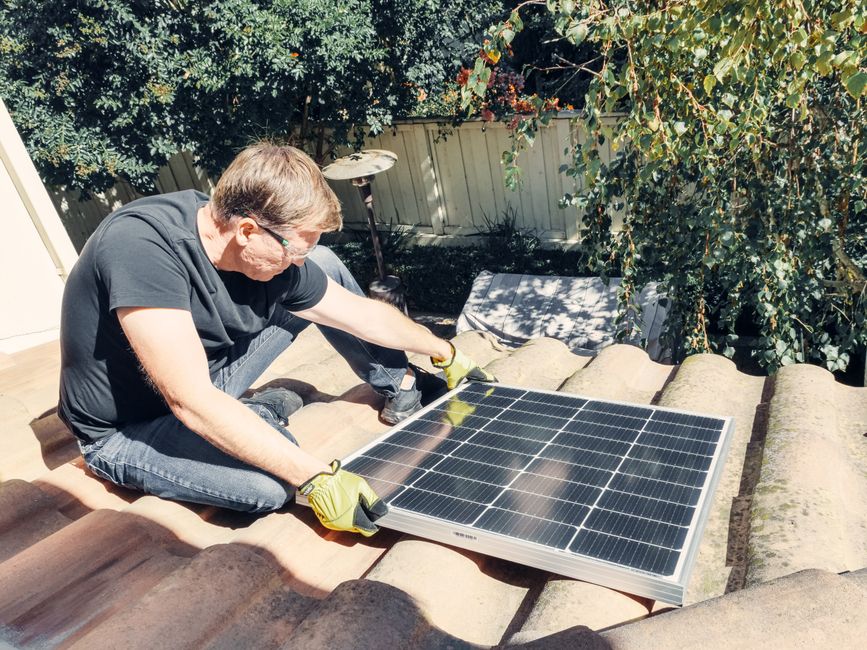
Photo: AI25.Studio AI GENERATIVE via Pexels
Recommended Resources
Disclosure: As an Amazon Associate, we earn a small commission from qualifying purchases at no extra cost to you. We only recommend products that genuinely support the topics covered in this article.
- Renogy 200W Solar Starter Kit + 30A Charge Controller (~$169), Complete beginner solar kit, 200W monocrystalline panel, charge controller, and mounting hardware included.
- Renogy 2×100W Monocrystalline Solar Panels (~$99), Expandable 200W panel set from the most trusted DIY solar brand, used widely in off-grid and home backup systems.