 Tom Bradley
Most people shopping for solar panels in 2026 spend way too much time comparing efficiency ratings and nowhere near enough time asking who’s actually going to be around to honor that 25-year warranty. That’s the thing nobody puts in the comparison chart.
I’ve been doing solar installs and consulting for long enough to have watched several “top-tier” brands quietly exit the US market, leaving homeowners with orphaned equipment and voided workmanship warranties. So before I get into who makes a good panel right now, I want to be honest: this market has shifted significantly even in the last 18 months, and some of the brand rankings you’ll find from 2023 or 2024 are already outdated.
Here’s where I actually started my research for this piece: EnergySage’s market data on installer preferences, combined with what I’m hearing from other installers in my network about what they’re actually willing to put their name behind. Not just what the manufacturers are paying to promote.
The Tier System Everyone Uses (And Its Real Limits)
You’ll see “Tier 1” thrown around constantly in solar marketing. I’ll be honest: it means less than you think. The Bloomberg NEF Tier 1 list is primarily a bankability rating. It reflects whether a manufacturer has secured institutional financing for projects. That tells you something about financial scale and production volume. It tells you almost nothing about actual panel quality, customer service, or whether that company will respond when you file a warranty claim in 2034.
What surprised me when I started looking closer is how many genuinely excellent panels come from manufacturers that aren’t on the Tier 1 list at all. And how many mediocre panels carry that exact designation.
The framework I actually use: look at domestic US presence (do they have an office here? US-based warranty support?), degradation rate (power loss per year), temperature coefficient (output drop in heat), and whether they offer both product warranty and separate performance warranty. Those last two are different things. Most homeowners don’t realize it.
The Brands Worth Talking About in 2026
| Brand | Efficiency | Temperature Coefficient | Warranty | Key Strength | US Presence |
|---|---|---|---|---|---|
| REC Group | 430-445W | -0.24%/°C | 25-year product/performance | Heat performance | European roots, solid US distribution |
| Maxeon Solar | 24%+ (400W) | Not specified | Intact warranty support | High efficiency, limited space | Monitored financial position |
| Qcells (Hanwha) | 21-22% | Not specified | 25-year linear/product | Quality + price + confidence | US manufacturing facility (Dalton, GA) |
| Longi Solar | 21-22.8% | Not specified | 25-year | Largest manufacturer, competitive pricing | Chinese manufacturer, logistics concerns |
| Canadian Solar | Not specified | Not specified | 25-year | Budget-conscious option | Questions on US warranty support |
| SunPower | Previously leading | Not specified | Warranty complicated post-2024 | Historical standard (now restructured) | Bankruptcy 2024, restructured |
REC Group keeps earning its reputation. The REC Alpha Pure and Alpha Pure RX series hit 430-445W for residential panels, with a temperature coefficient around -0.24%/°C. Genuinely impressive, especially for homeowners in Arizona or Texas where heat kills output. REC has European roots but solid US distribution, and their 25-year product/performance warranty has held up well in the handful of claims I’ve seen process. Not cheap. Expect to pay a $0.10-0.15 per watt premium over comparable JA Solar or Longi panels. Worth it for most installs? Probably yes, if your installer is comfortable with them.
Maxeon Solar, spun off from SunPower, makes panels I’ve consistently recommended for difficult roofs with limited space. Their Maxeon 7 series hits 24%+ efficiency in a 400W package, which is the best real-world efficiency you’ll find outside of research-grade products. The catch is price. You’re looking at a significant premium, and Maxeon has had financial turbulence. Their warranty support has remained intact so far. I’d be watching that situation carefully before signing a contract that locks you in.
Qcells (Hanwha Q CELLS) is what I recommend most often to homeowners who want strong quality, reasonable price, and warranty confidence. Korean-owned (Hanwha), with a manufacturing facility in Dalton, Georgia. That matters for Buy American provisions and supply chain resilience. Their Q.PEAK DUO BLK ML-G10+ and newer G11 series panels offer solid 21-22% efficiency at prices that won’t make your installer wince. The 25-year linear power warranty and product warranty are both strong. Hanwha isn’t going anywhere.
Longi Solar (LONGi) deserves more credit than it gets in US residential circles. They’re the largest solar panel manufacturer in the world by volume. Their Hi-MO 6 and Hi-MO X6 series panels are genuinely competitive on efficiency (21-22.8% depending on configuration) at prices that make system economics much more attractive. Some installers worry about warranty claim logistics with a Chinese manufacturer. I think that’s legitimate but somewhat overstated for most residential systems, because the 25-year timeline means you’re betting on corporate continuity regardless of who made the panel.
Canadian Solar sits nearby. Huge manufacturer, solid product, questions about long-term US warranty support infrastructure. Their HiDM 6 and BiHiKu7 series are technically strong. I’ve seen them installed on hundreds of houses without issues. For a budget-conscious homeowner whose primary goal is maximizing kWh per dollar, Canadian Solar is hard to argue against.
SunPower (distinct from Maxeon now) went through bankruptcy proceedings in 2024 and restructured significantly. This is the cautionary tale I mention to every client. SunPower was the gold standard for years. Their Maxeon cell technology was genuinely ahead of the market. And then the company imploded, leaving some dealers and homeowners in genuinely difficult positions mid-project. The panels themselves still work. But the warranty situation got complicated fast. The Solar Energy Industries Association (SEIA) has been pushing for better warranty protection standards partly because of what happened here.
What Actually Separates Good Panels From Great Ones
Do It Yourself Solar Power? - Easy DIY Solar Panel Installation! · JerryRigEverything on YouTube
Efficiency is the number that gets marketed hardest. It matters, but mostly in one specific situation: when you have limited roof space. If you’ve got a 2,000 square foot south-facing roof, the difference between a 21% and 22% efficient panel is basically a rounding error in your final system size. If you’ve got a small east-west facing roof and need to squeeze maximum output from 12 panels, efficiency becomes the deciding factor.
The spec I don’t see homeowners ask about enough: first-year degradation. Most panels lose about 2-3% of output in year one, then degrade more slowly afterward. Some premium panels now advertise 1% or even 0.5% first-year degradation. Over a 25-year system life, that compounds into meaningful total energy production difference. REC and Maxeon have historically led here.
Temperature coefficient is the other underrated number. A panel rated at 400W at Standard Test Conditions (25°C, basically a mild lab day) produces noticeably less on a 95°F July afternoon. The coefficient tells you exactly how much: -0.30%/°C is average, -0.24%/°C is quite good, -0.20%/°C is excellent. If you’re in Phoenix or Dallas or Atlanta, this number should matter to you more than the STC wattage.
Here’s what I’ll tell you from experience: the best panel from a brand your installer has never worked with is often worse than a slightly lesser panel from a brand they’ve installed 300 times. Installers who know a product know where the fragile connectors are, how to read the monitoring software, how to diagnose issues fast. Ask your installer which brands they have the most experience with before you insist on a specific product.
If you want to monitor your system’s performance independently of the installer’s app, a home energy monitor like the Emporia Vue is genuinely useful and runs about $100-130.
The Honest Take on Made-in-USA Claims
There’s been a lot of noise since the Inflation Reduction Act about domestic manufacturing. It’s real, and it’s worth caring about. Just be specific. Qcells in Georgia is genuinely domestic manufacturing. Some other brands have assembly operations in the US but source cells and wafers almost entirely from Southeast Asia or China. “Assembled in America” and “manufactured in America” are very different claims. Ask your installer for the bill of materials if this matters to you.
The research here is mixed on whether domestically manufactured panels actually perform better or fail at lower rates. What’s clearer is that domestic manufacturing tends to come with more accessible warranty support and less supply chain disruption risk. For a 25-year investment, that’s not nothing.
The brands at the top of the market in 2026 are genuinely better than what was available five years ago. Efficiency is up, prices are down, and the technology is more mature. What hasn’t changed is that a great panel installed poorly on an undersized system with a shaky warranty is still a bad investment. Get the installer right first. Then worry about the panel brand.
Sources
- EnergySage’s market data
- Solar Energy Industries Association (SEIA)
- a home energy monitor like the Emporia Vue
- Lutron Caséta Wireless Smart Dimmer Kit
- EG4 Battery Monitor Shunt for Solar Systems
Disclosure: As an Amazon Associate, we earn a small commission from qualifying purchases at no extra cost to you. We only recommend products that genuinely support the topics covered in this article.
- Renogy 200W Solar Starter Kit + 30A Charge Controller (~$169), Complete beginner solar kit, 200W monocrystalline panel, charge controller, and mounting hardware included.
- Renogy 2×100W Monocrystalline Solar Panels (~$99), Expandable 200W panel set from the most trusted DIY solar brand, used widely in off-grid and home backup systems.
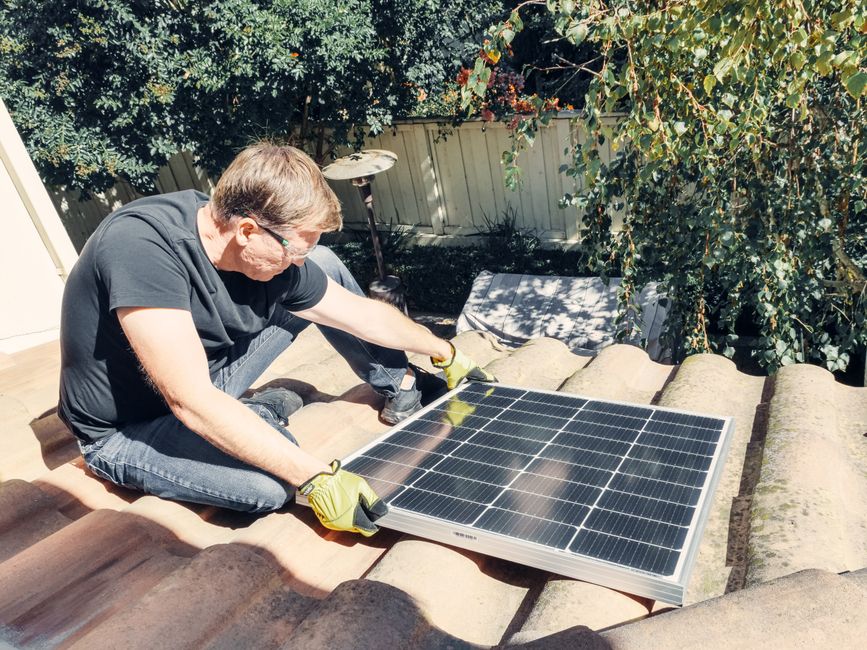
Photo: Mark Stebnicki via Pexels
Recommended Resources
Disclosure: As an Amazon Associate, we earn a small commission from qualifying purchases at no extra cost to you. We only recommend products that genuinely support the topics covered in this article.
- Renogy 200W Solar Starter Kit + 30A Charge Controller (~$169), Complete beginner solar kit, 200W monocrystalline panel, charge controller, and mounting hardware included.
- Renogy 2×100W Monocrystalline Solar Panels (~$99), Expandable 200W panel set from the most trusted DIY solar brand, used widely in off-grid and home backup systems.