 Tom Bradley
The federal solar tax credit gets all the headlines, but it’s completely useless if you don’t owe enough in federal taxes to claim it. I’ve watched low-income homeowners get pitched a 30% “discount” that they’ll never actually see, because nobody bothered to ask about their tax situation first. That single detail, the difference between a refundable and non-refundable credit, disqualifies a huge slice of the people who need solar savings the most.
So let’s skip the glossy pitch and talk about what actually works.
The Programs Most Installers Won’t Mention
| Program | Type | Income Limit | Max Benefit | Key Feature |
|---|---|---|---|---|
| WAP (Weatherization Assistance Program) | Grant | 200% of federal poverty level (~$62,400 for family of 4) | Varies by state | Covers solar under certain circumstances |
| USDA Section 504 (Rural) | Grant/Loan | 50% of area median income | $10,000 grant / $40,000 loan | 1% interest, 20-year repayment on loans |
| Illinois Shines | Grant | Income-qualified | Up to 100% of system costs | Low-income equity provision |
| Con Edison / NYSERDA (NY) | Community Solar | Income-qualified | 10% bill discount | Available to renters |
| SASH (California) | Grant | Income-qualified | Free system | Covers PG&E, SCE, SDG&E customers |
| SMART (Massachusetts) | Incentive | Low-income adders | Varies | Additional adders for low-income participants |
The 30% federal Investment Tax Credit (ITC), extended through 2032 under the Inflation Reduction Act, is real and it’s significant. But if your federal tax liability is $1,200 a year, a 30% credit on a $20,000 system gives you $6,000 you can’t use in year one. You can carry it forward, but if your income stays low, you may never collect most of it.
What most people don’t realize is that there are programs specifically designed around this problem. Ones that provide grants instead of credits, or that handle the installation entirely at no cost.
LIHEAP and WAP are the starting point. The Low Income Home Energy Assistance Program (LIHEAP) and the Weatherization Assistance Program (WAP) are federally funded but administered at the state level. In recent years, both have expanded to cover solar under certain circumstances. WAP in particular, which is run through the Department of Energy, has been quietly adding solar to its weatherization work for qualifying households. The income ceiling is 200% of the federal poverty level, which for a family of four in 2024 is roughly $62,400. If you’re in that range, WAP is the first call I’d make. Find your local WAP office at energy.gov.
USDA Section 504. If you’re in a rural area and you own your home, this one is worth knowing about. The USDA’s Rural Development program offers grants up to $10,000 and loans up to $40,000 specifically for low-income rural homeowners to make repairs and improvements that remove health and safety hazards. Solar qualifies as an improvement in many cases. The income limit for grants is 50% of area median income. For loans, it’s 50% of AMI as well, with repayment over 20 years at 1% interest. I’ve seen this program fly completely under the radar because “rural development” doesn’t scream “solar panels” to most people.
State and utility programs. This is where things get complicated and where you can find the most money. Some states have built serious low-income solar carve-outs into their broader incentive programs. Illinois has the Illinois Shines program, which includes an equity provision for low-income households that can cover 100% of system costs in some cases. New York’s Con Edison and NYSERDA both run community solar programs specifically targeted at income-qualified customers, with a 10% bill discount even if you’re a renter. California’s SASH (Single-family Affordable Solar Homes) program has provided free systems to qualifying Pacific Gas & Electric, Southern California Edison, and San Diego Gas & Electric customers. Massachusetts has the Solar Massachusetts Renewable Target (SMART) program, with adders for low-income participants.
The National Renewable Energy Laboratory has published research showing that low-income households spend three times more of their income on energy bills than higher-income households, and that solar could disproportionately benefit them, but only if the programs are structured to reach them. The gap between potential and reality is real, and part of it is just that people don’t know these programs exist.
How to Find What’s Available in Your State
I won’t sugarcoat this part: it’s annoying. The programs are fragmented, the websites are often outdated, and the income limits and application windows change regularly.
The most reliable starting point is the Database of State Incentives for Renewables and Efficiency at dsireusa.org. Filter by your state, look for solar-specific incentives, and read carefully for language like “low-income,” “equity,” “income-qualified,” or “disadvantaged community.” Those are the ones you want.
After that, call your utility directly and ask two specific questions: Do you have a low-income solar program, and do you have a community solar program with bill credit options for income-qualified customers? Utilities hate to advertise these aggressively because they’re spending ratepayer money, but the programs exist because regulators require them. You’re entitled to know.
Your state’s energy office is the third stop. Not the utility commission, not the EPA, the state energy office. Every state has one. They often know about local government and nonprofit programs that don’t show up in national databases.
One more thing: Habitat for Humanity affiliates in some regions are installing solar on the homes they build and rehab, and occasionally on existing homes for qualifying families. It depends entirely on the local affiliate, but it costs nothing to ask.
Community Solar Is Underused and Often Overlooked
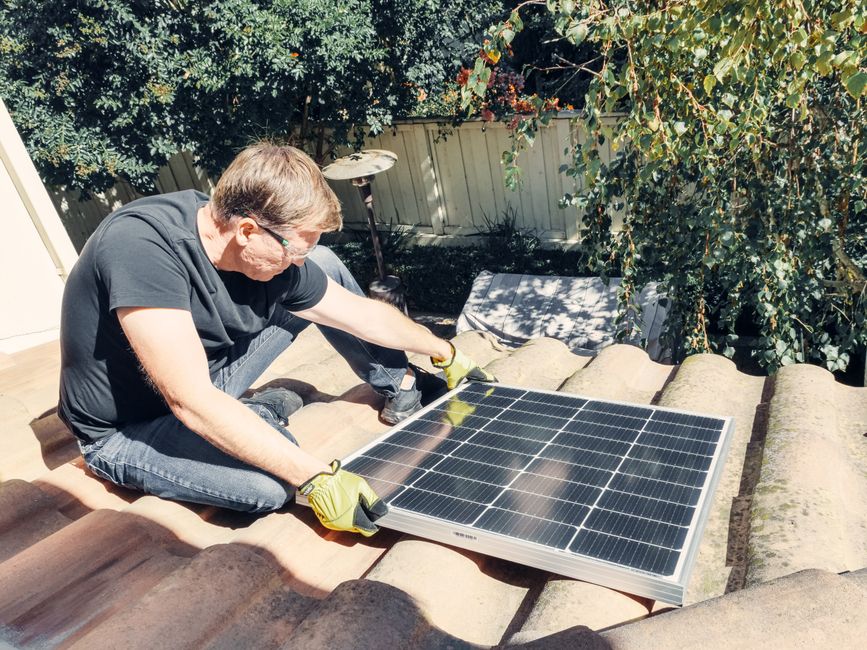
Do It Yourself Solar Power? - Easy DIY Solar Panel Installation! · JerryRigEverything on YouTube
If you own a home but your roof isn’t suitable for panels, or if the upfront cost is still a barrier even with incentives, community solar is genuinely worth your time.
Here’s how it works: a large solar farm is built somewhere in your utility territory, and you subscribe to a share of its output. That generation is applied to your electric bill as a credit. You don’t own the panels, nothing goes on your roof, and there’s nothing to maintain. Depending on the program, you can save between 5% and 15% on your electric bill with zero upfront cost, and income-qualified subscribers often get a larger discount or waived enrollment fees.
Community solar has expanded significantly since 2020. As of 2024, more than 20 states have active community solar markets. If you’re in Illinois, New York, Minnesota, Massachusetts, Maryland, Colorado, or New Jersey, there’s a good chance an income-qualified community solar option exists right now.
The catch is that waitlists can be long, sometimes one to two years in competitive markets. Sign up anyway. I’ve talked to homeowners who sat on a waitlist for 14 months and then started saving $400 a year with zero installation involved. That’s a good return on a 10-minute sign-up.
What the Installation Process Looks Like When It’s Subsidized
If you qualify for a fully or heavily subsidized program like WAP solar or a state equity program, here’s what to realistically expect.
The first step is an eligibility verification, usually income documentation, proof of homeownership, and sometimes a recent utility bill showing your average usage. Some programs also require a home energy audit first, because insulation and weatherization work may be done before or alongside the solar installation. That’s actually a good thing. A sealed, properly insulated house with solar panels will save you more than panels on a leaky house.
Once approved, you typically don’t choose your installer. The program has a list of qualified contractors who have agreed to the program pricing and quality requirements. That’s not ideal from a consumer choice standpoint, but the oversight usually means the work meets code, because the agencies administering these programs do get audited.
Permits are pulled by the installer. Your utility interconnection paperwork is handled by the installer. You shouldn’t have to do much beyond scheduling access to your home and signing documents.
One thing I’d tell anyone in this situation: take photos of your roof and attic before the work begins, and after. Not because these contractors are bad, but because documentation protects everyone. I’ve seen post-installation disputes about pre-existing damage that would have been resolved instantly if someone had taken 20 photos beforehand.
A home energy monitor can help you verify that your system is actually producing what it should after installation. It’s not required, but for a system you’re getting for free or near-free, it’s a reasonable investment to make sure the equipment is doing its job.
Red Flags to Watch For
Low-income homeowners are, unfortunately, a target for solar scams. The pitch usually goes: “We can get you a free solar system through a government program.” Sometimes that’s legitimate. Sometimes it’s a financing product dressed up as a grant.
A few things that should immediately make you cautious:
If someone shows up unsolicited and says you “qualify” for a free government solar program but needs you to sign paperwork right now, slow way down. Legitimate programs don’t work like this. You apply to them; they don’t recruit you door-to-door.
If the contract includes a solar loan or a Property Assessed Clean Energy (PACE) lien against your home, that’s not a free system. PACE financing in particular is controversial and has left some low-income homeowners with liens they didn’t understand. I’m not saying PACE is always bad, but if you were told it was a grant and it’s actually a lien, that’s a serious problem.
Ask for the specific program name and the government agency or utility administering it. If the salesperson can’t tell you, they don’t have what they’re claiming to have.
There are real dollars available for people who need them most. The programs exist. The barrier is usually awareness, not eligibility. If you’ve been told solar is only for people who can drop $25,000 on a system, that was true once and it isn’t anymore.
Sources
- National Renewable Energy Laboratory
- Renogy 200W Solar Starter Kit + 30A Charge Controller
- Renogy 2×100W Monocrystalline Solar Panels
- showing that low-income households spend three times more of their income on ene
Disclosure: As an Amazon Associate, we earn a small commission from qualifying purchases at no extra cost to you. We only recommend products that genuinely support the topics covered in this article.
- Renogy 200W Solar Starter Kit + 30A Charge Controller (~$169), Complete beginner solar kit, 200W monocrystalline panel, charge controller, and mounting hardware included.
- Renogy 2×100W Monocrystalline Solar Panels (~$99), Expandable 200W panel set from the most trusted DIY solar brand, used widely in off-grid and home backup systems.
Recommended Resources
Disclosure: As an Amazon Associate, we earn a small commission from qualifying purchases at no extra cost to you. We only recommend products that genuinely support the topics covered in this article.
- Renogy 200W Solar Starter Kit + 30A Charge Controller (~$169), Complete beginner solar kit, 200W monocrystalline panel, charge controller, and mounting hardware included.
- Renogy 2×100W Monocrystalline Solar Panels (~$99), Expandable 200W panel set from the most trusted DIY solar brand, used widely in off-grid and home backup systems.