 Tom Bradley
Most homeowners assume the permit process is the same everywhere. Pull a permit, get an inspection, flip the switch. I thought that too, right up until I was consulting on a project in Phoenix and realized Arizona handles interconnection approvals completely differently than California, where I’d done most of my work. The contractor nearly submitted the wrong utility paperwork. That one near-miss sent me down a research hole I’m still partially in.
The honest answer is that solar permitting in the U.S. is a patchwork, and not in a charming way. Jurisdiction matters more than the state line in many cases. A homeowner in unincorporated Riverside County, California faces different requirements than someone in the city of Riverside. Chicago has its own rules, separate from Illinois’s general guidance. This article tries to cut through that complexity with real specifics, current as of August 2026.
- Permit requirements vary by municipality, not just state; always check local AHJ (Authority Having Jurisdiction) rules.
- California's SB-379 and simplified permit processes cover systems under 10 kW, expect turnaround under 3 days in most jurisdictions.
- Florida and Texas have some of the fastest permit timelines; New York and New Jersey often run 4-8 weeks with utility coordination.
- Permit fees range from $0 (some Arizona municipalities) to over $1,200 in high-cost California jurisdictions.
- Interconnection approval from your utility is a separate process from the building permit, both are required before you can legally energize.
The Difference Between a Permit and Interconnection Approval
These two things get confused constantly, and I’ll be honest, I’ve seen experienced installers blur them in quotes. A building permit comes from your local government, the city or county’s building department. An interconnection agreement comes from your utility. You need both before your system can legally generate power and feed into the grid.
The building permit covers the structural and electrical installation. An inspector (usually a city building inspector) verifies that the racking is attached properly, conduit runs meet code, wire sizing is correct, and the AC disconnect is in the right place. The interconnection agreement is the utility’s approval to connect your system to their lines. Some utilities turn this around in a week. Others, I’m looking at you, Con Edison and some of the California investor-owned utilities, can drag it out for months if the grid in your area is congested.
One thing that surprises most homeowners: you often have to apply for interconnection before the system is even installed. Some utilities want the application concurrent with the permit application. Others review it separately. Check your utility’s specific tariff filing with your state’s public utilities commission. It’s dense reading, but it tells you exactly what they’re required to do and by when.
How Requirements Actually Break Down by State
Helpful resource: Lutron Caséta Wireless Smart Dimmer Kit is a top-rated option for this. (As an Amazon Associate this site earns from qualifying purchases.)
Rather than pretend I can cover all 50 states with equal depth, here’s a concrete breakdown of the states where I’ve either worked directly or done serious consulting research. What surprised me was how often “solar-friendly” states have the messiest permitting.
California adopted a streamlined permit process for residential systems under 10 kW, coditioned by SB-379 and refined over the years. In theory, you submit a standardized one-page application and the AHJ has to approve it within three business days. In practice, some smaller jurisdictions have pushed back on this, and a few still require structural engineering stamps even when the state says they don’t have to. The California Energy Commission maintains a list of compliant jurisdictions. Always verify against that list, not what the installer tells you.
Texas is peculiar. There’s no statewide solar permit requirement at all; it’s entirely local. Houston has no permit requirement for residential solar. Austin requires a permit but usually turns it around in about a week. Some rural Texas counties have no permitting at all. This isn’t necessarily good news. “No permit required” means no inspection, which means if something’s wired wrong, no one’s catching it before you energize.
Florida passed legislation that preempts local governments from blocking solar on zoning grounds, and the permitting process at the state level is relatively streamlined. Average permit processing runs 5-7 business days based on EnergySage’s installer network data. Utility interconnection in Florida is more variable. FPL (Florida Power & Light) has a dedicated solar team and processes applications reasonably fast. Some of the smaller rural co-ops are much slower.
New York and New Jersey are the slow ones. Both states have excellent incentives (NYSERDA’s programs, NJ’s SREC-II successor program), but the interconnection process through utilities like Con Edison or PSE&G can genuinely take 6-8 weeks. NYSERDA has a dashboard where you can track application queue times, and I’ve seen it run as high as 11 weeks during busy installation seasons.
Arizona is interesting. The state has a clear solar rights law that limits HOA restrictions and municipality overreach. Many cities, including Phoenix, Tempe, and Scottsdale, have adopted the SolarAPP+ platform (developed by the National Renewable Energy Laboratory), which automates permit approval for code-compliant systems and can issue approval in under an hour. Seriously. I’ve seen it happen.
Permit Fees: What to Expect (and What’s Ridiculous)
| State / Jurisdiction | Typical Permit Fee Range | Notes |
|---|---|---|
| Arizona (SolarAPP+ jurisdictions) | $0-$150 | Some cities waived fees entirely |
| Florida (statewide average) | $100-$400 | Varies widely by county |
| Texas (where required) | $75-$350 | Many jurisdictions charge zero |
| California (standard residential) | $250-$1,200 | SF Bay Area on the high end |
| New York (upstate) | $150-$500 | NYC is higher, $500-$800+ |
| New Jersey | $200-$600 | Plus utility interconnection fee |
| Massachusetts | $100-$450 | Plus electrical permit, often separate |
These fees are separate from any utility interconnection application fee, which typically runs $50-$200 depending on the utility. A few utilities still charge nothing. Some charge more. Check your utility’s current tariff schedule, not a blog post from three years ago.
What You Actually Need to Submit
I’m going to walk through what a typical permit application package looks like, because most guides handwave this. The specifics vary, but this is roughly what most AHJs want for a sub-10 kW residential grid-tied system:
- Site plan showing the house footprint, roof layout, panel locations, and setbacks from edges and ridgelines.
- Electrical single-line diagram showing module strings, inverter(s), AC and DC disconnects, utility meter, and interconnection point.
- Spec sheets for the panels and inverter (the manufacturer’s datasheet, which every reputable brand publishes as a PDF).
- Structural calculations or a stamped engineering letter if your roof is older, unusual pitch, or the AHJ requires it regardless.
- The utility interconnection application, often submitted separately but some AHJs want it bundled.
When I pulled the permit for my own home system back when I first transitioned from straight electrical work into solar, I thought I could submit a rough sketch for the site plan. The building department sent it back within 24 hours. They wanted it dimensioned, with the setback distances labeled explicitly. Lesson learned. Don’t make them chase you.
HOA Rules: A Separate Legal Layer
Your HOA does not have permit authority, but it can delay your project significantly if you don’t engage them early. Most states with strong solar markets have solar access laws that limit HOA restrictions. California’s law prevents HOAs from prohibiting solar outright. Arizona is similar. But “can’t prohibit” and “can’t slow you down with review processes” are different things.
Worked example: A reader in Scottsdale contacted me last spring after his HOA’s architectural review board sat on his application for 47 days. His city permit had been approved in 19 hours through SolarAPP+. The HOA was the bottleneck. Arizona law limits HOA review to 45 days for solar applications, so he was technically within his rights to proceed, but he wanted to avoid a fight with his neighbors. He filed a formal notice under ARS 33-1816, and the HOA approved within a week.
HOA restriction on panel placement is the gray area. They generally cannot prohibit a system on aesthetic grounds, but they can require panels be placed on rear-facing slopes when feasible. This can affect your production numbers by 15-20% or more depending on your roof orientation. Know that tradeoff before you agree to it.
Red Flags When Hiring an Installer
I’ve seen contractors skip permits entirely and tell the homeowner it’s “not required.” Sometimes that’s true. Often it isn’t. The Solar Energy Industries Association (SEIA) recommends always asking your installer for the permit number before they energize the system, and I’d go further: ask before they start installation. If they hem and haw, that’s your answer.
Worked example: A homeowner in suburban Chicago hired a small installer who said permits “take forever” in Cook County and they’d handle it after the fact. System went in. No permit pulled. Eighteen months later, the homeowner tried to sell the house. The buyer’s inspector flagged the unpermitted system. The homeowner had to pay $3,400 to have an engineer retroactively certify the installation and pull a post-construction permit, with corrections required.
Don’t let an installer talk you out of the permit. It protects you, not them.
Sources
- Solar Energy Industries Association (SEIA): Industry data on permitting trends, state policy tracker, and installation statistics.
- EnergySage Market Data: Installer survey data on permitting timelines, costs, and installer practices, updated quarterly.
- National Renewable Energy Laboratory (NREL) SolarAPP+: Documentation on the automated permit platform adopted by Arizona and other jurisdictions.
- California Energy Commission, Solar Permitting Compliance List (2026): Tracks which California jurisdictions comply with state-mandated streamlined permit requirements.
- Arizona Revised Statutes 33-1816: State law governing HOA restrictions on solar energy devices.
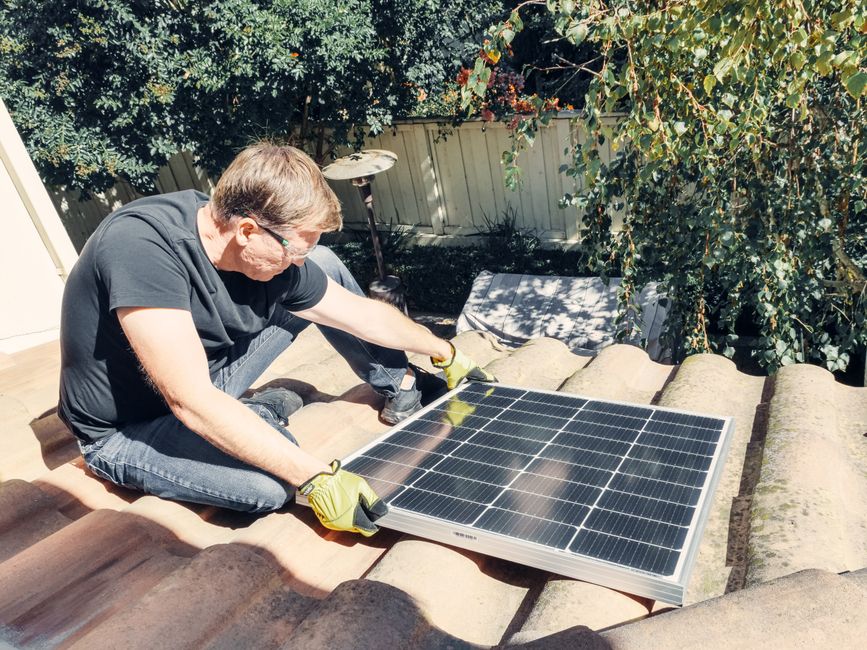
Photo: Robert So via Pexels
Recommended Resources
Disclosure: As an Amazon Associate, we earn a small commission from qualifying purchases at no extra cost to you. We only recommend products that genuinely support the topics covered in this article.
- Renogy 200W Solar Starter Kit + 30A Charge Controller (~$169), Complete beginner solar kit, 200W monocrystalline panel, charge controller, and mounting hardware included.
- Renogy 2×100W Monocrystalline Solar Panels (~$99), Expandable 200W panel set from the most trusted DIY solar brand, used widely in off-grid and home backup systems.