 David Torres
Six months. That’s how long a homeowner in a mid-Atlantic suburb waited between the day her panels were physically installed and the day her utility finally flipped the permission-to-operate switch. The system sat on her roof, fully wired, doing absolutely nothing for 183 days. She’s not an outlier. She’s closer to the median than most solar salespeople will ever admit.
I’ll be honest: when I started digging into interconnection timelines, I expected to find a story about paperwork delays. What I found instead was something more structural, and more frustrating. According to Lawrence Berkeley National Laboratory’s 2025 “Tracking the Sun” report, soft costs (permitting, inspection, interconnection) account for roughly 35% of the total installed cost of a residential solar system in the U.S. A meaningful chunk of that is just waiting. Waiting on utilities. Waiting on reviewers. Waiting on queues that utilities are not legally required to move quickly through.
EnergySage’s market data shows median interconnection timelines ranging from under 30 days in installer-friendly markets to well over 150 days in congested utility territories. That variance is enormous, and it’s the single biggest scheduling risk that almost no one talks about during the sales process. You sign a contract, you expect panels on your roof in 6-8 weeks. The part nobody mentions is what happens after the physical installation.
- Interconnection timelines range from under 30 days to 180+ days depending on utility territory.
- Physical installation typically takes 1-3 days; the waiting-for-utility phase is where projects stall.
- Some utilities process residential interconnection apps in under 2 weeks; others routinely take 4-6 months.
- Submitting a complete, error-free application on day one can cut processing time by 30-40%.
- Battery storage additions, utility-scale grid congestion, and older metering infrastructure all extend timelines.
What the Timeline Actually Looks Like, Step by Step
Most homeowners think of solar installation as one event. It’s not. It’s a sequence of five distinct phases, and the utility controls the last two of them entirely.
Phase 1: Permit application to approval (7-45 days). Your installer submits plans to your local Authority Having Jurisdiction (AHJ), usually your city or county building department. In smaller jurisdictions with SolarApp+ integration (a streamlined online permitting platform now adopted by hundreds of municipalities), this can come back in 24-48 hours. In others, you’re waiting three to five weeks for a plan checker who reviews solar drawings part-time.
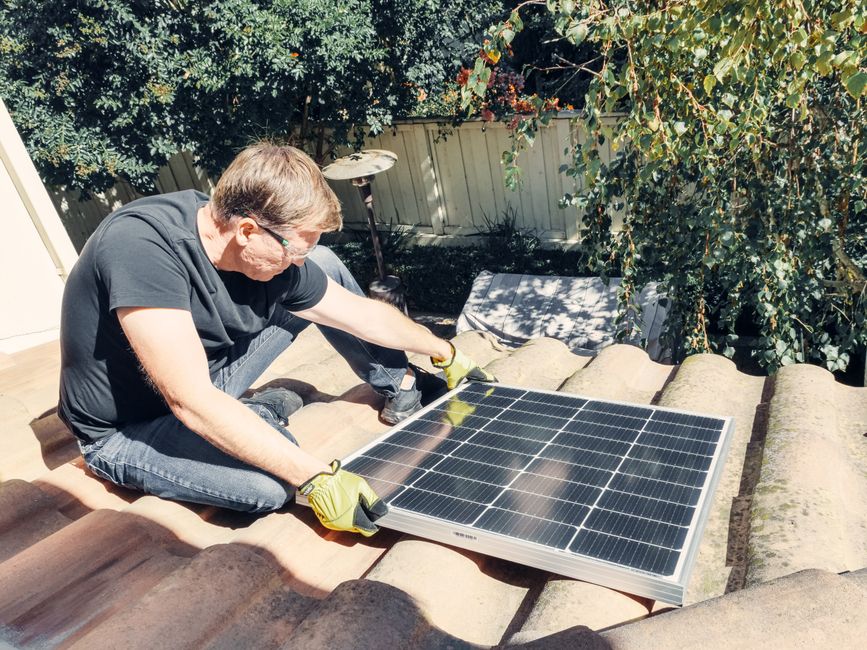
Phase 2: Physical installation (1-3 days). This is the fast part. A competent crew can rack, wire, and commission most residential systems in a single day. The work itself is rarely the bottleneck.
Phase 3: Building inspection (3-21 days). After install, you schedule an inspection with the AHJ. Most places get you on the calendar within a week. Some rural areas run 2-3 week backlogs.
Phase 4: Interconnection application review (14-180+ days). Here’s where it gets ugly. Your installer (or you, if you’re doing this yourself) submits an interconnection application to the utility. The utility reviews it, sometimes orders a supplemental study, and eventually either approves it or sends back revisions. This phase is almost entirely outside your control.
Phase 5: Utility meter work and PTO (3-30 days). After approval, the utility schedules someone to upgrade your meter to a bi-directional model or confirm your existing meter is compatible, then issues Permission to Operate (PTO). You cannot legally turn on your system before PTO. Some utilities issue PTO within days of approval. Others make you wait for a physical meter inspection appointment.
The total end-to-end timeline from permit submission to PTO in my experience ranges from about 6 weeks on the fast end (usually in states with strong solar markets and investor-owned utilities that have built out interconnection staff) to 7+ months in congested territories.
Why Some Utilities Are So Much Slower
Helpful resource: Renogy 100W 12V Flexible Solar Panel is a top-rated option for this. (As an Amazon Associate this site earns from qualifying purchases.)
What surprised me was how much utility interconnection speed correlates with regulatory pressure rather than utility size. Some of the largest utilities in the country process residential applications in under 3 weeks. Some small rural co-ops take 6 months. The difference is almost never staffing alone.
States with strong interconnection rules, like California under CPUC jurisdiction or New Jersey under its Board of Public Utilities requirements, enforce specific timelines with consequences for utilities that miss them. California’s Rule 21 interconnection standard mandates that utilities complete a simple residential fast-track application in 30 business days. When I’ve worked on projects in PG&E or SCE territory, the clock is real and utilities largely honor it. Compare that to certain states where interconnection rules are aspirational at best, and you get the 150+ day horror stories.
The Solar Energy Industries Association has been tracking this in its annual grid connection reports, and the pattern is clear: mandatory timelines with enforcement teeth produce faster outcomes. States without them see median wait times two to three times longer.
There’s also a technical wrinkle that catches people off guard. If your neighborhood has a lot of solar already, the utility may flag your application for a “supplemental review” or a full “distribution study” to assess grid impact. That study alone can add 60-120 days. I’ve seen it happen to homeowners installing modest 7 kW systems because five neighbors installed before them and the transformer was already running near capacity. Nothing wrong with their application. They just got unlucky with timing.
How Timelines Vary by Utility Territory
Here’s what the data actually looks like across some representative utility territories, based on SEIA reporting, installer feedback compiled by EnergySage, and my own project experience. These are 2025-2026 figures and reflect median residential interconnection time (Phase 4 only, not full project timeline):
| Utility Territory | Median Interconnection Time | Notable Rule / Factor |
|---|---|---|
| Pacific Gas & Electric (CA) | 21-35 days | CPUC Rule 21 enforcement |
| Southern California Edison (CA) | 20-30 days | Rule 21, well-staffed portal |
| PSE&G (NJ) | 25-45 days | BPU-mandated timelines |
| Duke Energy Carolinas (NC/SC) | 45-90 days | NC has soft interconnection rules |
| Dominion Energy (VA) | 60-120 days | High application volume, limited staff |
| National Grid (NY) | 45-90 days | Congested suburban feeders |
| Xcel Energy (CO/MN) | 30-60 days | Varies by feeder load |
| Co-ops and munis (various states) | 60-180+ days | Least regulatory pressure nationally |
These are medians. Individual projects can run longer. Adding battery storage almost always triggers a more complex review, which in my experience adds 2-6 weeks minimum even in fast-approval territories.
The Application Errors That Add Months
This is the thing I wish someone had told me earlier. Interconnection application rejections for missing or incorrect information are common, and each rejection restarts the review clock. I don’t have clean national statistics on rejection rates (I don’t think anyone collects them consistently), but anecdotally from contractor forums and installer groups, first-submission approval rates in complex utility territories run somewhere around 60-70%. That means 30-40% of applications go back for corrections.
Common errors that trigger rejections: wrong equipment specification sheets (the utility wants the specific inverter model’s spec sheet, not a generic brand sheet), incorrect single-line diagrams, missing anti-islanding verification documentation, wrong service address format matching their internal system. These sound trivial. They add 2-6 weeks per round trip.
The fix is straightforward, if tedious: use the utility’s own checklist and call their interconnection department before submitting to confirm which version of the application form is current. Forms change. I’ve seen projects get rejected because the installer submitted last year’s version.
Real example: A reader in Virginia, Marco, submitted his interconnection application in August 2025 with an inverter spec sheet that listed the model family rather than the specific model number. Dominion kicked it back 18 days later. He resubmitted with the correct sheet. Approved in 22 more days. Total delay from that one error: 40 days, nearly six weeks of his system sitting idle.
Another example: A contractor I know in rural Georgia installed a 9.6 kW system with a 10 kWh battery in spring 2025. The local co-op had never processed a battery-plus-solar interconnection application before. They sent it to their engineering department. Engineering took 11 weeks to complete an impact study. Total Phase 4 time: 94 days. The contractor now calls the co-op’s engineering contact before signing any battery contracts in that territory.
What You Can Actually Do to Speed This Up
You have less control than you’d like. But not zero.
Hire an installer who has existing relationships in your utility territory. This sounds like soft advice, but it’s concrete: installers who submit dozens of applications per year to the same utility often have a direct line to the interconnection team. They know exactly what documentation that utility wants, in what format, and who to call when something stalls. When I interviewed for a project in New England, I specifically asked the shortlisted contractors how many interconnection applications they’d filed with my local utility in the past 12 months. One said three. One said forty-seven. Guess which one I went with.
Ask your installer for the interconnection application tracking number and check the utility portal yourself. Most utilities have an online status portal now. I’ve seen installers not notice a rejection notice for two weeks because it sat in their email. You noticing it the day it arrives means you can call them immediately.
If you’re in a state with a strong public utilities commission, file a complaint if the utility blows past its mandated review window. PUC complaints actually move utilities. I’ve watched a stalled application get processed in 10 days after a formal complaint was filed.
Finally: do not schedule your electrical panel upgrade, battery installation, or EV charger setup for the same week you expect PTO. Schedule it for 3-4 weeks after you expect PTO. You will thank yourself.
Sources
- Lawrence Berkeley National Laboratory, “Tracking the Sun” 2025 report: Annual dataset on installed solar costs, soft cost breakdown, and installation timelines across U.S. residential systems.
- Solar Energy Industries Association (SEIA), Grid Connection and Interconnection Reports: Industry data on interconnection backlogs, state-by-state regulatory analysis, and processing time tracking.
- EnergySage Solar Market Intelligence Reports: Installer-reported data on project timelines, utility-specific interconnection performance, and consumer experience surveys.
- California CPUC Rule 21 Interconnection Standards: The model state interconnection rule with specific timelines and enforcement mechanisms referenced in this article.
- U.S. DOE Solar Energy Technologies Office, “Permitting and Interconnection” resources: Federal-level data on soft costs, SolarApp+ adoption, and permitting reform progress.
Photo: Kindel Media via Pexels
Recommended Resources
Disclosure: As an Amazon Associate, we earn a small commission from qualifying purchases at no extra cost to you. We only recommend products that genuinely support the topics covered in this article.
- Renogy 200W Solar Starter Kit + 30A Charge Controller (~$169), Complete beginner solar kit, 200W monocrystalline panel, charge controller, and mounting hardware included.
- Renogy 2×100W Monocrystalline Solar Panels (~$99), Expandable 200W panel set from the most trusted DIY solar brand, used widely in off-grid and home backup systems.